The deep relationship between humans and plants reaches back thousands of years, shaping not only survival but culture, medicine, trade, and modern wellness trends. Among plant traditions worldwide, Southeast Asian botanicals stand out for their cultural richness, medicinal heritage, and growing global relevance. These botanicals, from turmeric and ginseng to lesser-known ethnobotanicals, symbolize centuries of knowledge passed from healer to student, community to community.
Today, as demand for natural wellness products soars worldwide, the legacy of Southeast Asian botanicals is more visible than ever. Their journey from indigenous landscapes to global markets illustrates how science, tradition, regulation, and culture converge in the modern wellness ecosystem.
Ancient Origins of Botanical Wisdom
Indigenous Knowledge Systems
Before written history, communities across ancient Southeast Asia developed an intricate understanding of plant life. This mastery was rooted in observation, ritual, and practice, often communicated orally across generations. In these early systems, Southeast Asian botanicals were integral to community health, spiritual ceremonies, and daily nourishment.
Plants were not simply materials but living partners in survival. Elders maintained detailed knowledge of plant seasons, habitat, and interactions with human systems. Harvesting was done responsibly, respecting ecological balance, emphasizing the reciprocal relationship between people and land.
This knowledge system laid the foundation for what we now recognize as traditional medicine across Southeast Asia, where plant profiles were linked to body function, energy balance, and environmental adaptation.
Spiritual and Cultural Use
Across ancient Southeast Asian societies, plants were deeply symbolic. Healers often incorporated Southeast Asian botanicals into rituals intended to restore balance or ward off illness. In many regions, botanical remedies were paired with chants, prayers, or ethical protocols that reflected a holistic worldview.
In this system, the plant was never seen as a solitary cure, but as part of a broader cultural meaning: a connection between individuals, their community, and the environment. This perspective still resonates in modern holistic health movements that value balance and prevention over reactive treatment.
Traditional Medicine and Daily Practices
Integration Into Healing Traditions
As civilizations developed and grew more structured, botanical knowledge became part of formal healing systems. Southeast Asia’s rich medicinal heritage evolved alongside influences from Indian Ayurveda and Chinese medicine, yet maintained distinct regional identities.
In this context, Southeast Asian botanicals were used for a range of purposes: supporting stamina, aiding digestion, helping recovery after physical labor, and maintaining overall harmony. Households would keep dried herbs on hand, while local healers created plant-based formulas adapted to individual needs.
Among these traditions, Kratom occupies a notable cultural space. Though today the subject of regulatory debate in places like the United States, Kratom has historically been used in rural Southeast Asian communities as part of daily life routines rooted in cultural context rather than commercial trends.
The Role of Kratom
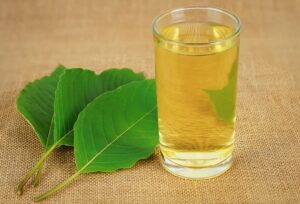
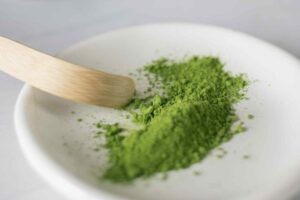
Kratom was traditionally consumed in simple ways, chewed leaves or brewed teas, and valued for its role within established local practices. Unlike modern processed forms, traditional use was tied closely to context, community norms, and centuries of empirical practice.
While modern research and Western markets treat Kratom differently, it’s important to understand that its traditional use reflects the broader principles behind Southeast Asian botanicals: respect for plant life, community standards, and cultural transmission of knowledge.
Expansion Through Ancient Trade Networks
Maritime Trade and Botanical Exchange
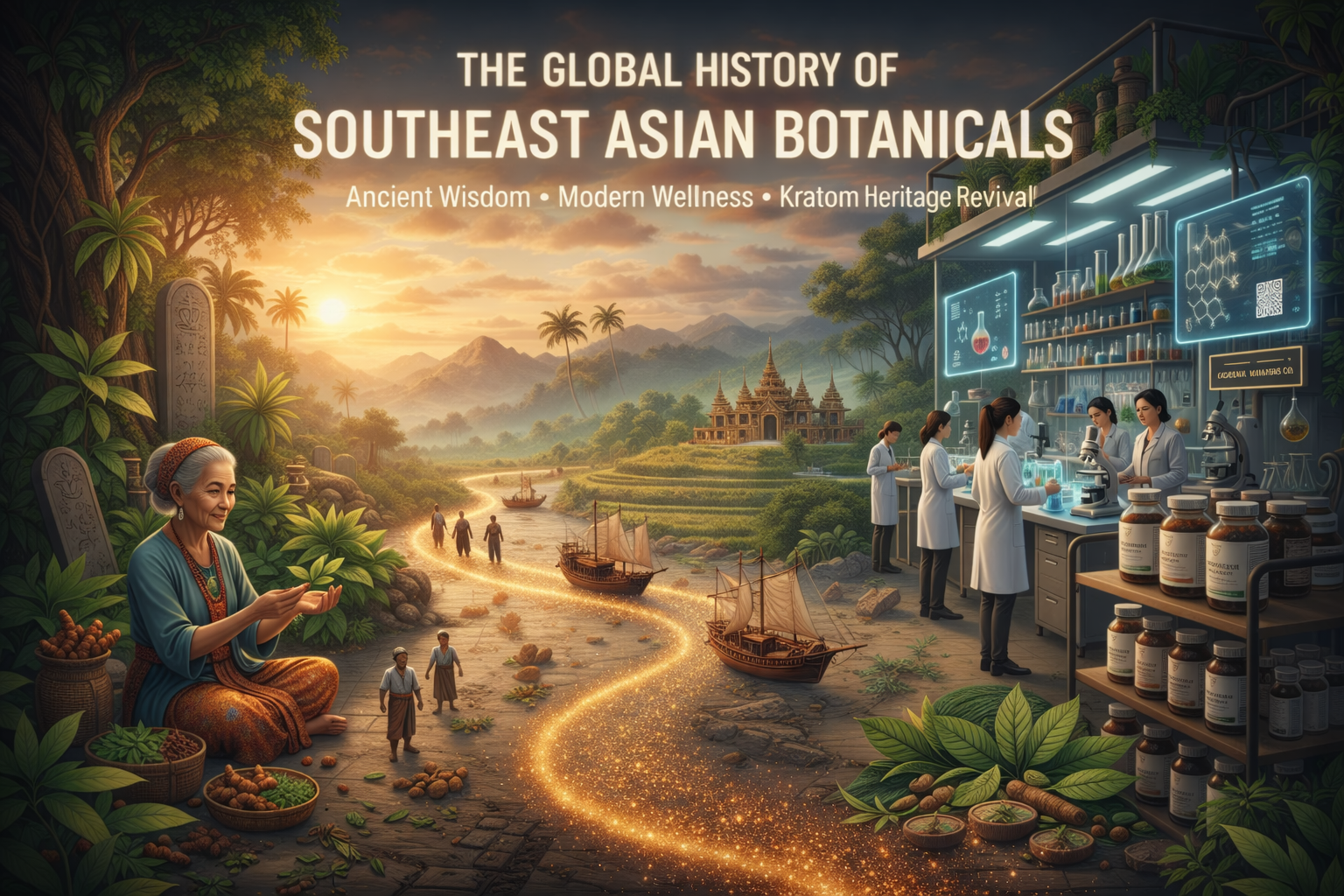
The global spread of Southeast Asian botanicals began with ancient trade routes. Merchants traversing maritime paths carried spices, resins, roots, and seeds to far regions, connecting Southeast Asia with India, the Middle East, Africa, and eventually Europe.
This exchange was not just commercial but cultural. Through trade, Southeast Asian botanicals gained international recognition, and early travelers documented plant uses in far-flung medical texts and herbal compendiums. These ancient routes enabled plant traditions to transcend regional boundaries and enter global knowledge systems.
Cultural Cross-Pollination
As Southeast Asian botanicals circulated through global trade, they influenced foreign health systems and inspired integrative approaches in preventive care. European apothecaries, for example, began incorporating spices and botanical ingredients into treatments, while Middle Eastern scholars wrote about Southeast Asian plant remedies in translated texts.
These early interactions laid the groundwork for the botanical exchange that continues today, forming a historical basis for cross-cultural botanical science.
Colonial Exploration and Scientific Documentation
Classification and Study
The colonial era marked a shift from local botanical traditions to formal scientific exploration. European expeditions to Southeast Asia catalogued plant life extensively, sending samples back to botanical gardens and laboratories for classification. This era accelerated the documentation of Southeast Asian botanicals but also detached plants from their cultural narratives.
Botanists like Carl Ludwig Blume and Joseph Banks contributed to the early scientific classification of Southeast Asian plant species, creating systematic botanical records that informed global understanding.
Traditional Knowledge Meets Science
While colonial science often focused on cataloguing, traditional knowledge continued to influence researchers. In recent decades, modern science increasingly acknowledged the value of traditional use as a starting point for understanding plant compounds. Christopher McCurdy, a medicinal chemistry professor at the University of Florida, remarks that the diversity of plant products often labelled generically (such as those sold in Western markets) ranges widely in composition and potency, a reminder of the complexity embedded in these ancient botanicals.
Modern Research and Botanical Innovation
Growth of Botanical Supplements
Globally, the botanical supplements market has grown substantially. In 2024, the global botanical supplements space was valued at over USD 54 billion, with projections estimating it will nearly double by 2032, reaching nearly USD 119 billion at a growth rate above ten percent annually. Much of this expansion is driven by increasing consumer interest in natural health, preventive wellness, and plant-based substitutes.
In the Asia Pacific, where many traditions of plant healing originated, the herbal supplements market alone generated more than USD 16 billion in 2024 and is forecast to grow steadily through the next decade.
Innovation in Extraction and Formulation
Scientific advances now allow researchers to isolate phytochemicals with greater precision and explore new delivery formats. According to industry research, over 60 percent of new botanical launches now use traceability technologies like QR codes for batch verification, and nearly half of research investment is directed at improving bioavailability, the measure of how effectively plant compounds are absorbed.
These innovations reflect a broader industry shift toward transparency, quality, and evidence-based botanical products.
Sustainability and Ethical Responsibility
Conservation Challenges
Rising global demand for plant-based wellness products creates pressure on ecosystems. Without sustainable practices, Southeast Asian botanicals could face over-harvesting, habitat loss, and biodiversity decline. Responsible sourcing is essential to preserve these botanical traditions and support ecological balance.
Conservation efforts focus on ethical harvesting protocols, certification systems, and community partnerships, ensuring that plants are used responsibly while supporting local economies.
Consumer Education and Transparency
Today’s consumers increasingly value traceability and environmental stewardship. Brands that emphasize responsible sourcing and scientific integrity help reinforce sustainable practices. This aligns with ancient principles of reciprocity and respect for nature deeply embedded in the history of Southeast Asian botanicals.
Cultural Renaissance: Kratom and Beyond
Kratom in Contemporary Policy
Recent policy shifts in regions like Thailand illustrate a renewed interest in traditional plants. Thailand’s government funded major research initiatives to support local botanical research and promote herbs, including Kratom, as part of economic and wellness strategies, underscoring cultural recognition of these botanicals’ heritage and economic potential.
Balancing Tradition and Modern Demand
This renaissance reflects broader global interest in responsibly integrating traditional plant knowledge into innovation and commerce. It highlights the importance of preserving cultural context while engaging global markets.
Conclusion: A Living Legacy
The global history of Southeast Asian botanicals is a testament to human ingenuity, cultural continuity, and nature’s enduring influence on wellbeing. From ancient healer practices to global market trends, these plants carry centuries of insight into modern conversations about health, sustainability, and cultural respect.
Their legacy reminds us that plant traditions are not static relics but living knowledge systems, offering guidance for future wellness landscapes when approached with respect, scientific curiosity, and ethical stewardship.